
By: Michael C. Korting
|
09/10/2026

How collaboration among technology, finance, and business teams can turn cloud spending into measurable business value.
As cloud and hybrid computing environments continue to co-exist, the need to bridge IT operations with business and financial accountability has become increasingly important. That is where FinOps continues to gain traction among IT professionals, finance teams, and business leaders. More than a cost-management discipline, FinOps provides an operating model for maximizing the business value of cloud and technology investments through shared ownership, governance, forecasting, and continuous optimization. This is especially relevant to Sycomp’s Managed Cloud Services strategy, including Sycomp Intelligent Cloud+ and the company’s expanding FinOps capabilities with Apptio Cloudability, which helps customers gain deeper visibility into cloud spend, strengthen governance, improve forecasting, and optimize multi-cloud investments.
For many IT professionals, cloud adoption started with promises of agility, scalability, and faster innovation. Those benefits are real. Unfortunately, so are the surprises that arrive when the monthly cloud invoice shows up.
Organizations often discover that spinning up cloud resources is much easier than understanding who owns them, why they exist, and whether they are delivering business value. FinOps was created to address exactly that challenge by bringing together technology, finance, and business stakeholders to make smarter decisions about cloud spending.
Key Takeaway
FinOps is not simply a cost-cutting exercise. It is an operating model for making cloud spending visible, accountable, and connected to business value.
The Evolution of Cloud Spending
Traditional IT procurement was relatively straightforward. Organizations purchased hardware, software, and infrastructure through formal budgeting and procurement cycles. Costs were typically predictable and capitalized over multiple years.
Cloud computing changed everything.
Today, engineers can provision services almost instantly. Teams can deploy workloads in minutes rather than waiting weeks or months for procurement approval. While this flexibility accelerates innovation, it also introduces a new set of financial challenges:
- Decentralized purchasing
- Variable consumption-based spending
- Rapid scaling capabilities
- Multi-cloud environments
- Constantly changing pricing models
Cloud spending has shifted from predictable capital expenditures to dynamic operational expenses that can fluctuate daily.
For organizations embracing Azure, AWS, Google Cloud, or multiple cloud platforms simultaneously, keeping track of costs becomes increasingly difficult.
So What Is FinOps?
FinOps, a portmanteau of Finance and DevOps, is commonly described as an operational framework and cultural practice that helps organizations maximize the business value of technology investments through collaboration between engineering, finance, and business teams, with roots in cloud cost management and an expanding scope across SaaS, licensing, data centers, data cloud platforms, and other technology categories.
At its core, FinOps is about answering a few simple questions:
- Who is spending money in the cloud?
- What are they spending it on?
- Is that spending generating business value?
- How can we optimize costs without slowing innovation?
Rather than viewing cloud costs as purely a finance problem, FinOps treats cost management as a shared responsibility.
Just as cybersecurity is no longer solely the responsibility of the security team, cloud financial accountability is no longer solely the responsibility of accounting.
The Three Phases of FinOps
One concept that stood out during my training is that FinOps is not a one-time project. It operates as a continuous lifecycle with three core phases.
The FinOps lifecycle continuously moves through Inform, Optimize, and Operate.
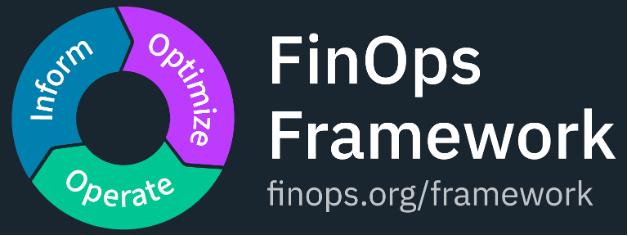
Source: FinOps Framework by FinOps Foundation
1. Inform
The first step is gaining visibility. Organizations need to understand where spending occurs and allocate costs to the appropriate teams, applications, or business units. This phase focuses on reporting, cost allocation, analytics, and forecasting.
Typical questions:
- Which departments generate the most cloud cost?
- How much does a specific application cost to operate?
- Are expenditures tracking against budget?
2. Optimize
Once visibility exists, optimization begins. This phase focuses on identifying waste, rightsizing resources, improving commitment utilization, and eliminating unnecessary spending. Organizations analyze whether resources are overprovisioned, idle, or underutilized.
The goal is not simply to spend less. The goal is to spend wisely.
3. Operate
The final phase focuses on operationalizing good financial practices. This includes forecasting, budgeting, KPI tracking, automation, governance, and connecting technology spending directly to business outcomes.
Successful organizations continuously cycle through all three phases as workloads and business priorities evolve.
Common Cloud Cost Challenges
Many organizations struggle with the same issues when attempting to mature their cloud operations:
- Inconsistent tagging standards
- Limited cost allocation capabilities
- Difficulty managing multi-cloud environments
- Lack of visibility into container costs
- Overprovisioned workloads
- Unexpected cost spikes
- Complex discount and commitment programs
- Challenges linking costs to business outcomes
These blockers often prevent organizations from understanding whether their cloud investments are truly delivering value.
What Does a FinOps Specialist Actually Do?
This was one of my biggest questions when I started exploring the discipline.
A FinOps Specialist does not simply build reports or chase cost savings. Instead, the specialist acts as a bridge between technology teams, finance departments, and business leadership.
|
Responsibility |
Description |
|
Cost Visibility |
Helping organizations understand where cloud spending originates and who owns it. |
|
Cost Allocation |
Establishing chargeback or showback models that assign costs to the right departments, applications, or products. |
|
Optimization |
Identifying opportunities to eliminate waste, rightsize resources, and improve utilization. |
|
Forecasting and Budgeting |
Building more accurate cloud spending forecasts and helping teams manage growth responsibly. |
|
Governance |
Creating guardrails that reduce waste while still enabling innovation. |
|
Business Value Measurement |
Connecting technical spending to meaningful business outcomes. |
The Better Question
A good FinOps practitioner helps an organization answer not only “How much are we spending?” but also, “What are we getting for that spending?”
Why FinOps Matters More Than Ever
Cloud adoption continues to accelerate. Organizations are not only managing traditional infrastructure anymore. They are also dealing with:
- Containers and Kubernetes
- Artificial Intelligence workloads
- Data platforms
- Multi-cloud environments
- Software-as-a-Service ecosystems
As environments become more complex, financial accountability becomes even more important. Many organizations have reached the point where spreadsheets and native cloud reporting tools can no longer provide the visibility and governance they need.
FinOps provides a structured approach that scales alongside cloud maturity.
This is also where Sycomp’s Managed Cloud Services approach becomes important. Sycomp Intelligent Cloud+ brings together cloud assessment, migration planning, governance, compliance, cost optimization, consolidated billing, spend tracking, forecasting, Kubernetes cost allocation, and user-friendly reporting to help organizations better manage cloud performance and financial accountability across AWS, Google Cloud, and Microsoft Azure.
For me, learning FinOps is not just an academic exercise. It directly supports the way Sycomp helps customers connect cloud operations with measurable business outcomes through Intelligent Cloud+ and FinOps services powered by Apptio Cloudability.
My Early Takeaways
As someone who has spent years focused on Microsoft 365, security, compliance, governance, and cloud architecture, FinOps feels surprisingly familiar.
- Visibility drives accountability.
- Governance enables scale.
- Technology decisions should align with business outcomes.
- Metrics matter.
- Automation improves consistency.
Just as security has evolved from an IT responsibility into an organization-wide discipline, cloud financial management is following a similar path.
The organizations that succeed in the cloud will not necessarily be those that spend the least. They will be the organizations that understand what they are spending, why they are spending it, and how that investment creates measurable business value.
That is ultimately what FinOps is all about.
Final Thoughts
FinOps has become an essential discipline for organizations that need to manage technology investments with the same rigor they apply to security, compliance, and operational governance. As cloud, hybrid, Kubernetes, SaaS, and AI-driven workloads continue to expand, the ability to connect consumption, ownership, optimization, forecasting, and business value is no longer optional. It is a core requirement for mature cloud operations and a natural extension of Sycomp’s Managed Cloud Services portfolio, including Sycomp Intelligent Cloud+ and Sycomp’s FinOps services with Apptio Cloudability.
Whether your organization runs workloads in Azure, AWS, Google Cloud, Kubernetes, or a combination of platforms, understanding cloud economics is becoming just as important as understanding cloud architecture.
The next level of FinOps maturity is not simply about identifying savings opportunities. It is about building repeatable practices around cost allocation, unit economics, Kubernetes and container visibility, commitment management, forecasting, anomaly detection, automation, and executive reporting so organizations can make more informed decisions about where and how they invest.
“The cloud may be elastic, but budgets are not.”
References
About the Author

Michael C. Korting is a Senior Microsoft 365 Consultant at Sycomp with more than 15 years of experience helping organizations modernize their technology platforms through cloud adoption, security transformation, and digital workplace solutions. He specializes in Microsoft 365, Copilot, identity and access management, endpoint management, compliance, and Zero Trust security architectures, with extensive experience leading enterprise migrations, modernization initiatives, and governance programs
Throughout his career, Michael has partnered with organizations ranging from small businesses to enterprise clients, delivering solutions that improve security, collaboration, operational efficiency, and user experience. As a recognized Microsoft technology expert, he regularly shares practical insights on Microsoft 365, security, compliance, AI, and emerging cloud technologies through his professional blog and industry content.
Other Resources
How Sycomp Turned a Customer’s Supplier Requirement Into a Competitive Edge

AI Readiness Starts with Data Protection: Turning Unknown Exposure into an Actionable Roadmap
Sycomp Helps Medical Device Manufacturer Modernize Security and Network Infrastructure
